

Claude Tag vs Merlin: Vendor Lock-In or Model Agnostic
 Dott
Someone on your team just asked to add @Claude to Slack, and you're the one who has to sign off on it. Before you connect your workspace and start a usage balance, the question in the back of your head is how hard it would be to leave Anthropic six months from now if OpenAI ships a better coding model, or if your team splits between Claude Code and Codex.
Most comparisons frame this around a model picker, and get it wrong on the first line. Claude Tag already lets anyone in a Slack thread switch between Opus and Sonnet models by asking, so model selection inside one vendor is solved. Real lock-in in a Slack agent sits across four layers: whose models you can run, whose machines do the work, where your team's accumulated knowledge lives, and who bills you.
Claude Tag puts all four layers with Anthropic, though it leaves you a clean exit for any skills and repo rules you keep in git. Merlin splits the layers up by driving the Claude Code and Codex agents already installed on your teammates' own machines, while keeping routing, channel memory and automations in Merlin. If you're just here for a quick recommendation, start with these.
The short answer
- You're all-in on Anthropic and want zero infrastructure to babysit: Claude Tag. Anthropic runs the cloud sandboxes, manages the connectors, and bills channel work to one organization usage balance.
- Your engineers use both Claude Code and OpenAI Codex: Merlin. A teammate can switch from Claude Code to Codex mid-thread, and set reasoning effort per task.
- You want the agent to use local MCP servers,
~/.claudeconfigs and unpushed branches: Merlin. Claude Tag runs in a clean cloud sandbox where local settings and checked-in.mcp.jsonfiles never load. - You want to reuse the Pro, Max or ChatGPT Plus subscriptions your team already pays for: Merlin, which charges a flat workspace fee and runs model usage on each machine owner's existing plan.
- You need the agent inside Linear issues and GitHub PR comments as well as Slack: Merlin. Claude Tag lives in Slack and opens draft PRs through its GitHub App.
- You want an easy exit if you switch tools next quarter: check the exit audit. Both tools keep your
CLAUDE.mdand skills portable, and both trap your channel memory and scheduled routines in their own storage.
Claude Tag and Merlin at a glance
| Dimension | Claude Tag | Merlin |
|---|---|---|
| Best for | Teams standardized on Claude Team or Enterprise who want a managed cloud sandbox in Slack | Teams running Claude Code, Codex or both who want to use their own machines, local tools and existing plans |
| Models you can run | Anthropic Opus and Sonnet families, fast mode on Opus, default effort only | Every model and reasoning-effort level exposed by your installed Claude Code and OpenAI Codex CLIs |
| Where the work runs | Anthropic-managed cloud sandbox per thread, or self-hosted runners on your network | Your teammates' own Macs, Linux boxes or servers running Claude Code or Codex |
| Where knowledge lives | Anthropic stores transcripts, channel memory, routines and connectors (not in org data exports during beta). Skills and CLAUDE.md stay in git | Merlin stores channel memory (as editable Markdown), automations and routing. Skills and CLAUDE.md / AGENTS.md stay on disk and in git |
| Who bills you | Claude Team ($20 to $125/seat/mo, 2-seat min) or Enterprise, plus a funded org usage balance for channel work | Merlin workspace plan ($19 to $99/mo total), plus whatever Claude or ChatGPT plans your team already uses |
| Where you can use it | Slack channels, threads and DMs (opens draft PRs via the Claude GitHub App) | Slack, Linear issue delegation and GitHub PR or issue mentions |
| Leaving later | Keep git skills and CLAUDE.md, and lose transcripts, channel memory and routines upon uninstall | Keep local skills, CLAUDE.md, AGENTS.md and local agent configs, and rebuild Merlin automations and copy out Markdown memory |
Prices and features were seen on November 1, 2026.
Which models you can run
Claude Tag is Anthropic's native Slack teammate, built for organizations on Claude Team or Enterprise that want Claude in channels without managing local machines. Merlin is a workspace layer for engineering teams that routes tasks from Slack, Linear and GitHub to the Claude Code and OpenAI Codex agents running on their own hardware.
Claude Tag
- Available in public beta since its June 23, 2026 launch, Claude Tag gives you the Opus and Sonnet families. Anthropic manages the catalog and your admins can narrow which models your workspace allows.
- Anyone in a thread can switch models in plain English (
@Claude switch to Claude Opus 5.5 for the rest of this thread) or set a channel default, and every reply footer names the model that answered. If an admin pins a scope to a model family, sessions move to the newest model in that family automatically when Anthropic ships one. - If an Owner allows it, typing
@Claude !fastturns on fast mode for Opus models at a higher per-token price. Reasoning effort is locked down: as the docs for Claude Code users note, "Effort level: Not configurable. Sessions run at the model's default effort."
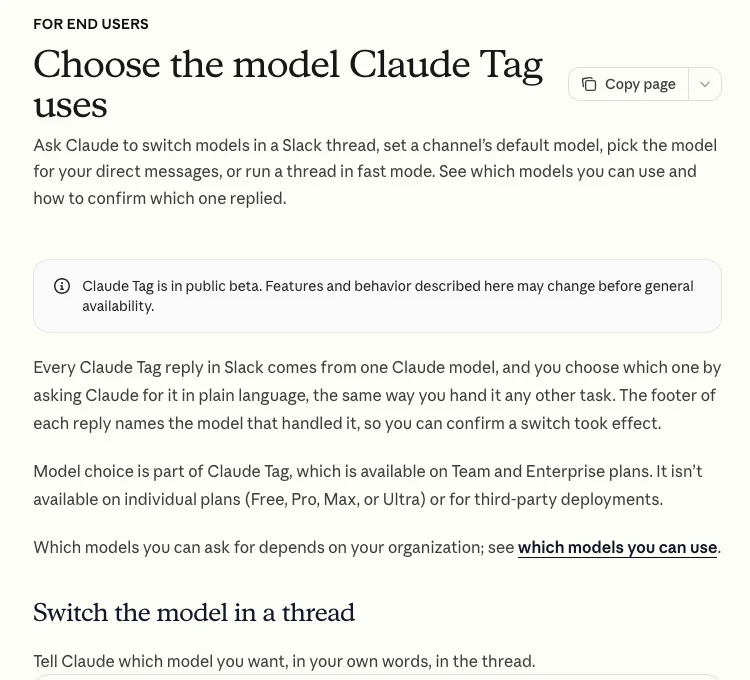 Claude Tag lets anyone in a thread switch between the Claude models the organization allows.
Merlin
- Merlin does not host a model or sit between your prompts and the provider. A runtime in Merlin is simply an instance of Claude Code or OpenAI Codex on a teammate's machine, so you get two model vendors: Anthropic and OpenAI.
- The runtime owner picks the default model, the reasoning effort from the levels that model supports, and the mode (such as fast mode) from what the local CLI reports. Merlin validates all three against the provider's live catalog before a task starts.
- Anyone asking for work in a thread can override those settings in their own words (
use max effort,switch to my Claude agent,use Alice's Codex) for a single turn or the rest of the thread. The ceiling is two vendors: Merlin only drives Claude Code and Codex, so Gemini and open-weight models are off the table.
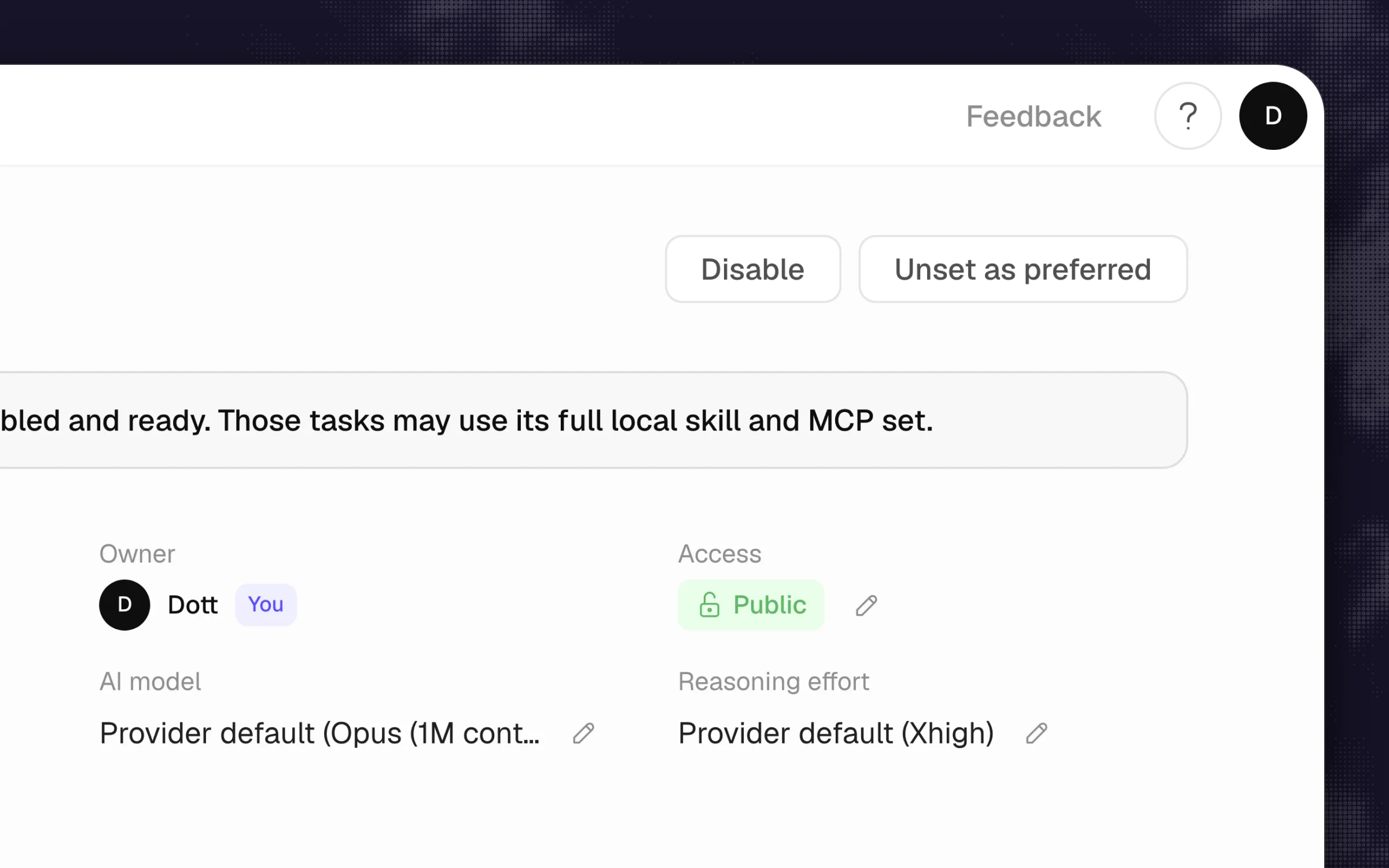 In Merlin, the runtime owner picks the model and reasoning effort from what Claude Code or Codex reports.
My read: If you want to pit Opus 5.5 against GPT-6.1 Sol in the same Slack channel, or dial reasoning effort up to ultra for a gnarly migration, only Merlin does that. If you're happy staying inside Anthropic's lineup and don't care about tuning effort levels, Claude Tag's natural-language model switcher is effortless.
Where the work runs
Where the agent executes commands decides two things at once: how much setup your team has to maintain, and whether the agent can see the tools your engineers already configured on their laptops.
Claude Tag
- Claude Tag runs the same engine as Claude Code, and each Slack thread gets an isolated session inside an Anthropic-operated cloud sandbox (the same infrastructure behind Claude Code on the web) or an organization-pinned environment.
- Your local machine settings never touch the session:
~/.claude, personalsettings.json, shell environment variables, hooks in.claude/settings.json, and local MCP servers are ignored. Even if you check an.mcp.jsonfile into your repository, Claude Tag does not load it. After cloning a granted repo, it readsCLAUDE.md,.claude/rulesand.claude/skills, and reaches external services strictly through channel connections where Anthropic's Agent Proxy injects credentials at the network boundary. - Teams that need code to stay inside their perimeter can run self-hosted environments on runners inside their own network. The trade-off is that self-hosted sessions cannot use the cloud connectors an admin configures in the workspace.
Merlin
- When you mention
@Merlin, the request runs on a machine a teammate controls where Claude Code or Codex is already installed and signed in. One MacBook or Linux server can expose both agents at the same time. - Because it runs locally, a public runtime uses the owner's local environment, enabled skills and locally configured MCP servers right out of the box. Each conversation gets its own working directory, though Merlin does not add an OS sandbox or run under a separate user account, so sharing a runtime means trusting teammates with that machine's local access.
- The hardware catch is obvious: at least one runtime has to be online. If a teammate closes their laptop lid and goes to lunch, their personal runtime shows as offline until they wake it up or someone routes the task to an always-on team box.
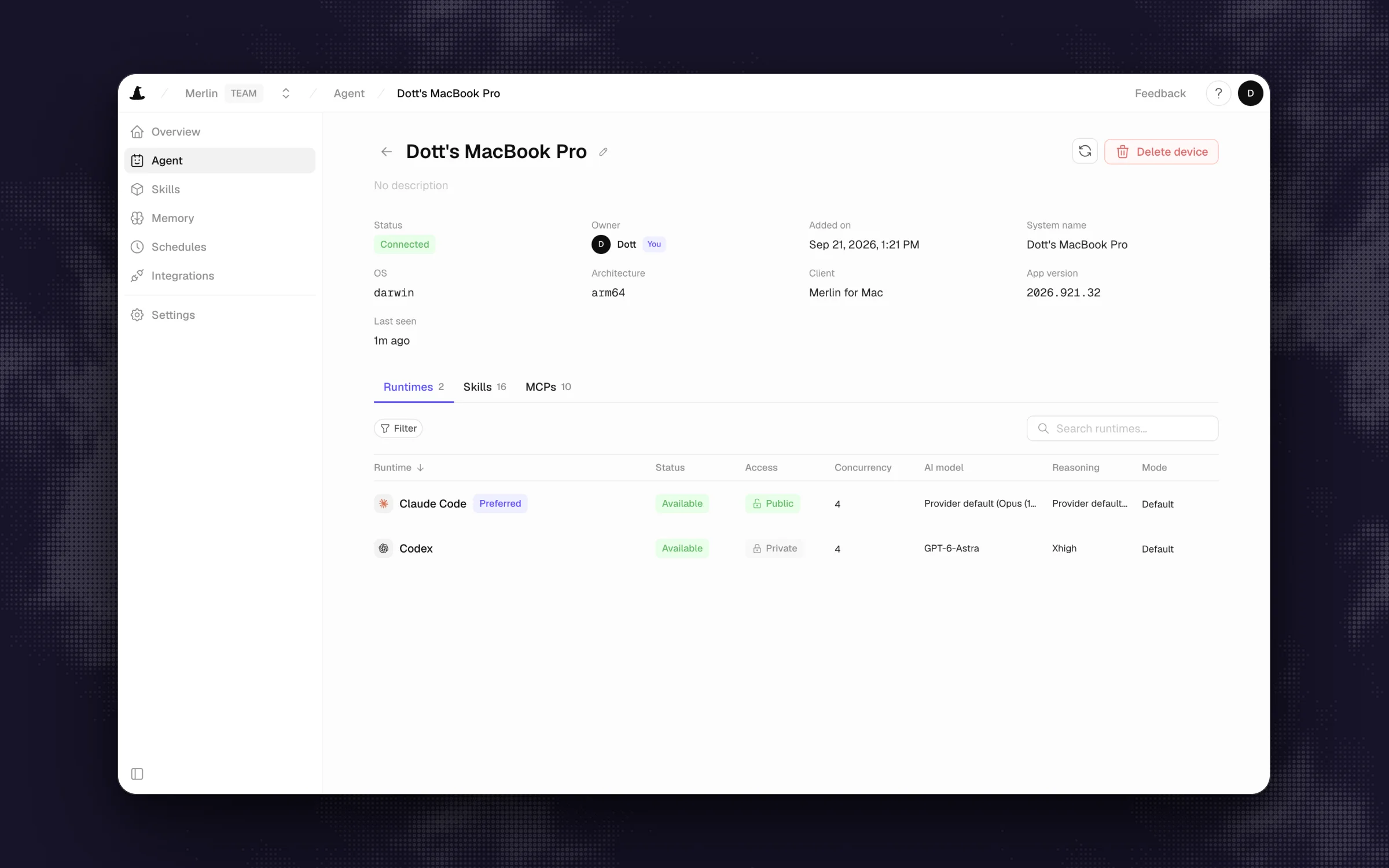 One teammate's machine can offer both Claude Code and Codex, each with its own model and settings.
My read: Claude Tag wins on security isolation and zero maintenance: nobody's laptop needs to be awake at 2 a.m. for a channel request to succeed. Merlin wins when the whole point of the task is reaching the local MCP servers, private CLIs, database tunnels and .claude setups your engineers spent months tuning.
Where your team's knowledge piles up
Code changes end up in GitHub either way. The quiet lock-in is everything else the agent accumulates after a few months in Slack: channel facts, past debugging transcripts, recurring schedules and shared skills.
Claude Tag
- For every paired Slack workspace, Anthropic stores session transcripts, memory (channel, workspace and DM notes), scheduled routines, scopes, connector credentials and published artifacts on its own servers.
- During the public beta, there is no automatic retention cutoff, your organization's custom retention rules don't apply to transcripts or memory, and "Claude Tag session transcripts and memory aren't included in your organization's data exports, and the Compliance API doesn't list or delete Claude Tag sessions."
- The bright spot for portability is skills: Claude Tag uses the exact same
SKILL.mdformat as Claude Code. Admins can back organization skills with a git repository structured like a Claude Code plugin marketplace, and Claude can open pull requests against that repo when it learns a better workflow.
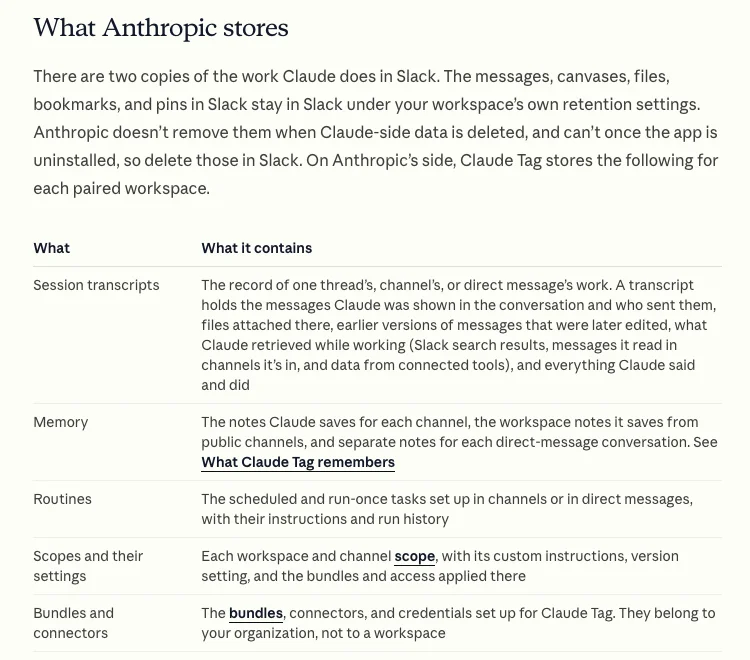 Everything Claude Tag learns in your channels is stored on Anthropic's side, and during the beta it isn't in your data exports.
Merlin
- Merlin stores channel memory as short facts in small Markdown files per Slack channel, indexed by a
MEMORY.mdfile. In the web app, members can browse the memory stores their channel membership allows, and owners and admins can edit or delete the files. - Shared skills are discovered directly from
~/.claude/skillsand~/.agents/skillson your teammates' connected machines, alongside a workspace catalog, so the skills on disk work identically when you run Claude Code or Codex in a terminal without Merlin. - Automations (cron schedules and event triggers) and runtime preferences and workspace settings live in Merlin's cloud. If you cancel Merlin, you keep every skill and repo instruction on your machines, and you'd need to copy your Markdown memory files out of the web app and move your cron triggers elsewhere.
My read: Both tools respect the open file standards (CLAUDE.md, AGENTS.md and SKILL.md folders), so your repo instructions and skills are safe in either setup. For channel memory and transcripts, Merlin's browsable Markdown files are easier to audit and copy out today than Claude Tag's beta storage, which currently sits outside Anthropic's org data export and Compliance API.
Who bills you
Neither tool charges a per-Slack-user fee just for being in the workspace, and both split the bill into a platform requirement plus model consumption.
Claude Tag
- You need a Claude Team or Enterprise plan on Anthropic's first-party service. Free, Pro, Max, Ultra and third-party deployments cannot install Claude Tag. On Anthropic's pricing page, Team seats cost $20 per seat per month billed annually ($25 monthly) for Standard, or $100 annual ($125 monthly) for Premium, with a two-seat minimum. Enterprise starts at a 20-seat minimum.
- Work in public channels, private channels and group DMs draws from a shared organization usage balance that an Owner funds, capped by a monthly spend limit at list token prices. Team plans start with a $0 balance, so Claude won't answer in channels until an Owner adds funds. One-to-one DMs from a connected member bill to that member's own seat.
- Anthropic is upfront about budgeting for channel tasks: "There's no published per-task cost guidance."
Merlin
- Merlin bills per workspace per month, after a 14-day Team trial: Starter is $19/month (up to 5 active users and 1,000 requests), Team is $59/month (up to 50 users and 5,000 requests), and Scale is $99/month (up to 200 users and unlimited requests).
- Merlin never touches your model billing or asks for an API key during setup. Every task uses the Claude Pro, Claude Max, Claude Team, ChatGPT Plus, ChatGPT Pro or API account already signed in on the runtime machine that picks up the job.
- The trade-off lands on whoever owns a shared runtime: work routed to a teammate's public runtime counts against that runtime owner's own Claude Code or Codex plan and usage limits.
My read: If your teammates already pay for individual Claude Pro or Max plans and ChatGPT Plus or Pro subscriptions, Merlin keeps model usage on each machine owner's own Claude Code or Codex plan for $19 to $59 a month per workspace, without standing up a Claude Team org and a separate metered usage balance. If you want clean central accounting where channel work never touches an engineer's personal coding quota, Claude Tag's org usage balance is built for that.
Where you can use it
Where a task starts matters when half of your bug reports arrive in Slack and the other half live in issue trackers and pull requests.
Claude Tag
- Slack is the primary surface (if you're weighing it against Slack's built-in assistant, see Claude Tag vs Slackbot). Teammates talk to
@Claudein channels, threads and direct messages. - When a task produces code, Claude Tag pushes branches and opens draft pull requests through the Claude GitHub App.
Merlin
- You can mention
@Merlinin Slack threads, mention@Merlinon GitHub issues and pull requests, or delegate an issue to Merlin in Linear. - All three surfaces route to the same pool of Claude Code and Codex runtimes on your team's machines and report their progress back to the thread or issue where you asked.
My read: If your workflow starts and ends in Slack, both cover it. If your engineers live in Linear and GitHub review comments and want to trigger the exact same local agents from there, Merlin saves you from stitching together separate GitHub Actions and Linear bots.
What leaving looks like
When you evaluate vendor lock-in, the easiest test is an exit audit: if you uninstall the app on Friday afternoon, what still works on Monday morning?
| Layer | If you leave Claude Tag tomorrow | If you leave Merlin tomorrow |
|---|---|---|
Repo instructions (CLAUDE.md, AGENTS.md, .claude/rules) | Keep. They live in your git repositories and work in local Claude Code or Codex immediately. | Keep. They live in your git repositories and on your teammates' disks. |
Skills (SKILL.md) | Keep if you backed your org skills with a git repo, since they use the standard Claude Code skill format. | Keep. Skills live in ~/.claude/skills and ~/.agents/skills on your machines. |
| Local MCP configs and hooks | Nothing to migrate. Claude Tag never loaded your local ~/.claude or .mcp.json files in the first place, though you lose your admin-configured cloud connectors. | Keep. Your local MCP servers and hooks stay inside your local Claude Code and Codex setups. |
| Channel memory and transcripts | Lose. Uninstalling or disconnecting deletes workspace data on Anthropic's side, and during beta transcripts and memory aren't in org data exports. | Export by hand. Channel memory sits in browsable Markdown files (MEMORY.md) in the Merlin web app, which you can copy into your repos before leaving. |
| Routines and automations | Lose. Scheduled routines live in Anthropic's workspace storage and have to be rebuilt elsewhere. | Lose. Scheduled and event-driven automations live in Merlin and have to be rebuilt in cron or CI. |
| Model subscriptions | Tied to Anthropic. Your Team or Enterprise seats and funded usage balance only run Claude models. | Keep. Your team's Claude and ChatGPT plans keep working in their local terminals and IDEs as before. |
Which one should you pick
Three questions about your team's setup settle this decision quickly.
- Are you standardizing on Anthropic alone, or running a two-vendor shop? If your company has a Claude Team or Enterprise agreement and no appetite for OpenAI Codex, Claude Tag is the native path. If half the team swears by Opus 5.5 in Claude Code and the other half prefers GPT-6.1 Sol in Codex, Merlin lets both camps share one Slack handle.
- Do you want cloud sandboxes or local environments? Pick Claude Tag if you want every Slack request isolated in a fresh cloud container (or a locked-down self-hosted runner) with zero access to anyone's laptop. Pick Merlin if you want the agent to use your local MCP servers, local scripts and existing machine state, and you have a workstation or server that stays awake.
- How do you want to pay for model tokens? Pick Claude Tag if finance wants one centralized Anthropic invoice with a funded org usage balance for channel work. Pick Merlin if you already pay for Pro, Max or Plus seats and want to route Slack, Linear and GitHub tasks where model usage stays on each machine owner's own plan for a flat monthly workspace fee.
4 things most comparisons skip
- Claude Tag is multi-model within Anthropic. Several third-party comparison blogs claim Claude Tag locks you into a single fixed model. It doesn't: anyone can switch between Opus and Sonnet in a thread, and model-family defaults automatically upgrade when Anthropic releases a newer version.
- Reasoning effort is where the model controls actually diverge. Claude Tag locks sessions to the model's default effort level. Merlin lets the runtime owner set a default reasoning effort and lets anyone in Slack ask for higher or lower effort on a single task.
- Your checked-in
.mcp.jsondoes not load in Claude Tag. Engineers moving from terminal Claude Code to Claude Tag are often surprised that neither~/.claudenor a repository's.mcp.jsonis read in cloud sessions. Every external integration has to go through an admin-configured channel connector instead. - Merlin's model agnosticism stops at two vendors, and Merlin is its own layer. Merlin gives you Anthropic and OpenAI through their official coding CLIs, not arbitrary open-weight models or Gemini. And while your skills and subscriptions stay yours, your automations, runtime preferences and workspace settings live inside Merlin.
FAQ
No. Within Anthropic's catalog, anyone in a Slack thread can ask @Claude to switch between the Opus and Sonnet models your organization allows, or turn on fast mode with @Claude !fast. What you cannot do in Claude Tag is change the reasoning-effort level or run a non-Anthropic model such as OpenAI's GPT-6.1 Sol.
During the public beta, Claude Tag session transcripts and memory are not included in your organization's data exports, and Anthropic's Compliance API does not list or delete Claude Tag sessions. Disconnecting the workspace or uninstalling the Slack app deletes that workspace data on Anthropic's side. Any skills and CLAUDE.md files you keep in your git repositories remain yours.
No. Claude Tag requires a Claude Team or Claude Enterprise plan on Anthropic's first-party service, plus a funded organization usage balance for work in channels and group DMs. If your team is on individual Claude Pro, Claude Max or ChatGPT Plus plans, Merlin lets you drive those existing accounts from Slack.
No. Merlin routes your requests from Slack, Linear and GitHub to the Claude Code or OpenAI Codex CLI already installed and signed in on a teammate's machine. You pay Merlin a flat monthly workspace fee ($19 to $99 per month), and all token usage stays on the Anthropic or OpenAI account signed in on that machine.
You keep them. Both Claude Tag and Merlin use the standard SKILL.md folder format from Claude Code (and Codex's ~/.agents/skills), along with CLAUDE.md in your repositories. If you store your Claude Tag organization skills in a git repository, you can clone that same repository onto a teammate's machine and use those skills in Merlin the same day.
If your company is already on Claude Team or Enterprise and wants a managed cloud sandbox that runs while every laptop is asleep, Claude Tag is the straightforward pick, especially if you keep your skills in a git repo. If your engineers use both Claude Code and Codex, depend on local MCP tools, or want one agent across Slack, Linear and GitHub with model usage staying on each machine owner's own plan, Merlin is the better fit.
Try Merlin for free
Hand work to Claude Code and Codex from Slack, Linear and GitHub. Free for 14 days, no API keys, no card required.
Get started for free