

Viktor vs Merlin: Credit Billing or Your Own Subscription
 Dott
You've seen Viktor's ads promising a flat $50 a month instead of $30 per seat, or you've already burned through the free starter credits in Slack, and meanwhile the engineers on your team are paying $20 to $200 a month each for Claude or ChatGPT. You want an AI coworker in Slack that the whole company can ask for help, and you're trying to figure out whether to put it on Viktor's shared credit pool or on the subscriptions your team already carries.
Both tools skip per-seat pricing, and both have a ceiling. Viktor's ceiling is a dollar pool: every reply, scheduled run, browser step and long thread spends shared credits at $0.0025 each, and when the pool hits zero Viktor pauses until an admin pays for more. Merlin's ceiling is the usage limit of the Claude or ChatGPT plan on the machine doing the work: the monthly bill stays flat, and a heavy week hits a five-hour or weekly quota that resets on its own. Your real choice is which ceiling you'd rather manage.
If you're just here for a quick recommendation, start with these.
The short answer
- Nobody on the team runs Claude Code or Codex locally, and you want one-click SaaS connectors in a hosted cloud sandbox: Viktor. It arrives with its own cloud computer and 9,800+ managed connectors.
- Your engineers already pay for Claude or ChatGPT and have local repositories, MCP servers and CLIs set up: Merlin. Workspace plans start at $9 a month, and model usage stays on the machine owner's own subscription.
- You want predictable monthly spend even when people run big coding or research tasks: Merlin. A 20-step workflow and a two-line Slack answer both count as one request.
- You need Microsoft Teams, Discord, email or hosted internal web apps: Viktor. Merlin covers Slack, Linear and GitHub only and hosts no apps.
- You want native Linear agent sessions and GitHub pull request work using local Git credentials: Merlin.
- You want to see the wider field before picking: read the roundup of 12 Viktor alternatives.
Viktor and Merlin at a glance
| Dimension | Viktor | Merlin |
|---|---|---|
| Best for | Teams wanting a cloud-hosted Slack, Teams or email agent with 9,800+ managed SaaS connectors and credit billing | Software teams of 5 to 200 whose engineers already run Claude Code or Codex and want Slack, Linear and GitHub on those plans |
| How you pay | Free up to 40,000 starter credits once, Team from $100/mo for 40,000 shared credits ($0.0025/credit), Enterprise custom | Starter $9/mo (up to 3 active users, 1,000 requests), Team $59/mo (up to 50 users, 5,000 requests), Scale $99/mo (up to 200 users, unlimited requests), plus your own Claude or Codex plans |
| Where the work runs | Viktor's AWS cloud sandbox (us-east-1, EU on Enterprise), SOC 2 Type 1, zero-retention model terms | Claude Code or Codex on your team's own machines via an outbound client connection |
| Permissions | Most SaaS connections default to shared with everyone in the workspace, personal mail and calendar start private, per-tool confirmation settings | New runtimes start private to the device owner, who can make a runtime public to delegate execution |
| Integrations | 27+ native integrations, 9,800+ Pipedream-based managed connectors, remote HTTPS MCP servers | Any local or remote MCP server, CLI, repository or skill installed on the connected machine |
| Where your team asks & code work | Slack, Microsoft Teams, Discord, email, web, desktop and Android, clones GitHub repos in its cloud sandbox to open PRs | Slack, Linear (native agent sessions) and GitHub (@usemerlin-ai on issues and PRs using local checkouts) |
| Proactivity & automations | Twice-daily Heartbeat, Workflow Discovery DMs, scheduled tasks and event triggers (AI runs spend credits, script-only runs are free) | Opt-in Slack channel response modes, scheduled and webhook/event automations pinned to the creator's runtime |
| Memory | Stored as personal and shared skills, refined overnight, any member can edit personality and instructions | Markdown files per Slack channel with message citations, public vs private channel separation, off by default |
| Models | Anthropic Claude, OpenAI and Google Gemini routed by Viktor (Ultra, Smart, Balanced, Cheap presets) | Anthropic (via Claude Code) and OpenAI (via Codex) only |
Prices and features were seen on November 12, 2026.
What a month of work costs on each
Viktor's pricing page and credit guide estimate a quick task at 100 to 300 credits, a complex workflow at 500 to 1,500 credits and a full project at 2,000 to 5,000 credits. Viktor's plans documentation prices every current plan at $25 per 10,000 credits, which is $0.0025 per credit. On Merlin's pricing, one conversation or automation run counts as one request regardless of how many steps it takes, and model usage goes to the Claude or ChatGPT subscription on the machine doing the work. The tables below price the same month of work for a 10-person team and a 3-person team, counting a weekday scheduled digest as a quick task on Viktor.
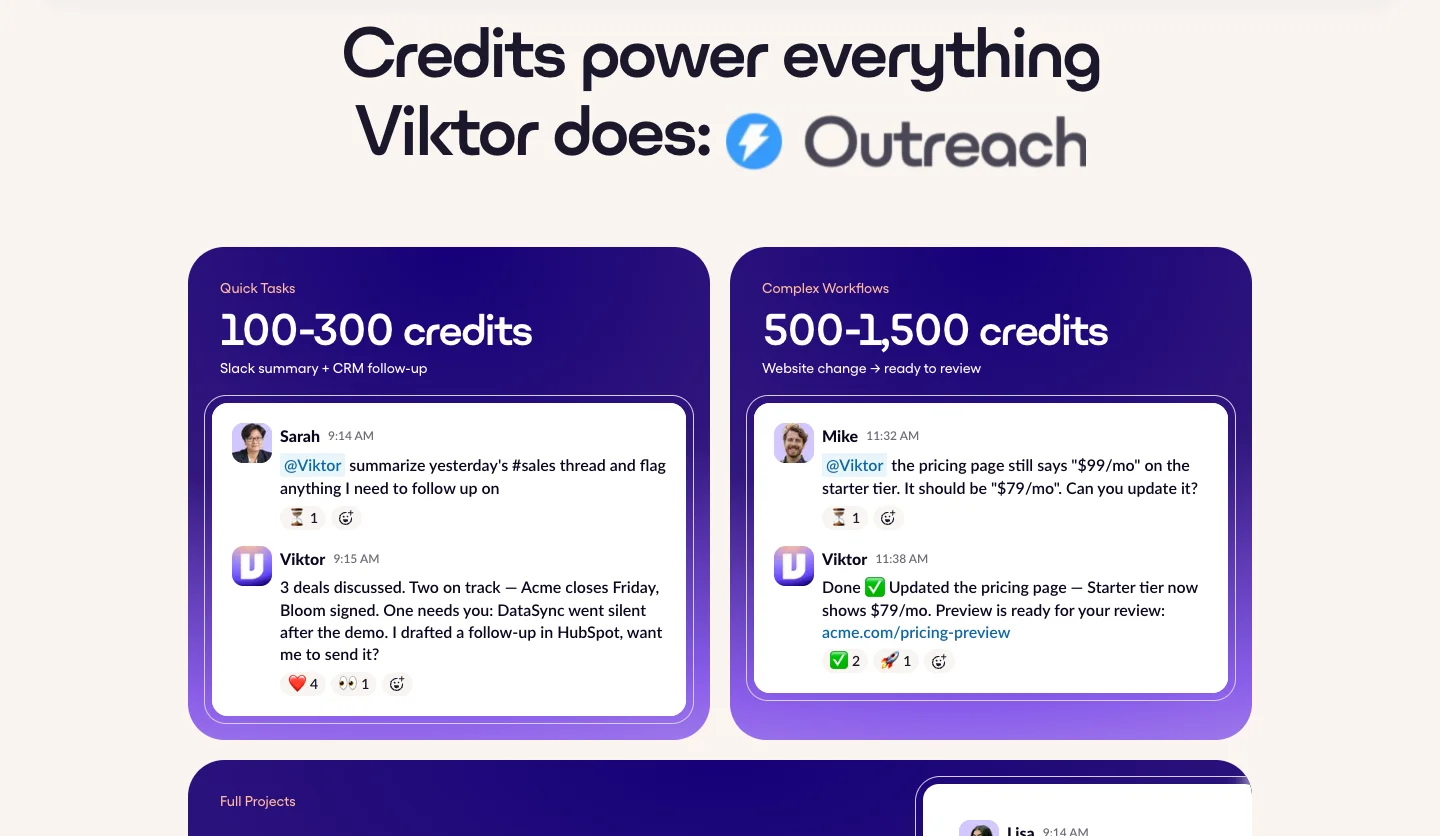 Viktor's own per-task estimates are the starting point for any monthly budget.
A 10-person team, one month
| Work in the month | Count | Viktor credits (low to high) | Viktor cost | Merlin requests |
|---|---|---|---|---|
| Quick tasks (thread summary, CRM lookup, status answer) | 200 | 20,000 to 60,000 | $50 to $150 | 200 |
| Complex workflows (a page change ready to review, a multi-tool report) | 60 | 30,000 to 90,000 | $75 to $225 | 60 |
| Full projects (an internal app, a multi-step build) | 8 | 16,000 to 40,000 | $40 to $100 | 8 |
| Weekday scheduled digest | 22 | 2,200 to 6,600 | $5.50 to $16.50 | 22 |
| Total | 290 | 68,200 to 196,600 (midpoint ~132,400) | $171 to $492 (midpoint ~$331) | 290 |
- Viktor: the $100 Team plan's 40,000 credits cover between a fifth and three fifths of this workload. At the midpoint of 132,400 credits, the month comes to about $331: for example the $300 plan (120,000 credits) plus about $31 of auto top-ups at the plan rate of $25 per 10,000 credits, or the $400 plan (160,000 credits) with unused credits rolling over for one month.
- Merlin: the $59 Team plan covers up to 50 active users and 5,000 requests, so 290 requests sit well inside the cap. If two engineers on the team already pay for Claude Max ($100 a month) or ChatGPT Pro (from $100 a month) and make their runtimes public with spare quota, the added software bill is $59. If you buy a dedicated subscription for a shared always-on machine, add $100 for Claude Max or $200 for Claude Ultra, putting the total at $159 to $259 (excluding any one-time hardware cost for a spare Mac mini or Linux box).
A 3-person team, one month
| Work in the month | Count | Viktor credits (low to high) | Merlin requests |
|---|---|---|---|
| Quick tasks | 60 | 6,000 to 18,000 | 60 |
| Complex workflows | 15 | 7,500 to 22,500 | 15 |
| Full projects | 2 | 4,000 to 10,000 | 2 |
| Weekday scheduled digest | 22 | 2,200 to 6,600 | 22 |
| Total | 99 | 19,700 to 57,100 (midpoint ~38,400) | 99 |
- Viktor: 19,700 to 57,100 credits works out to $49 to $143. The midpoint of 38,400 credits fits right inside the $100 Team plan's 40,000 credits, and Viktor's one-time free starter pool (up to 40,000 credits) covers roughly the first month.
- Merlin: the $9 Starter plan covers up to 3 active users and 1,000 requests, running alongside the $20 Claude Pro or ChatGPT Plus plan a founder already has. Light weeks stay inside a $20 plan, while a heavy coding week can bump into five-hour limits and nudge that person up to a $100 Max or Pro tier.
Three takeaways stand out from the math:
- Light use lands close, and volume pulls them apart. For a three-person team doing light work, Viktor is $100 a month after the free trial and Merlin is $9 on top of a subscription you already pay for. By 10 people, Viktor scales with every task while Merlin's workspace fee stays flat at $59.
- Viktor's bill is only as predictable as your task mix. Adding three extra full projects in a busy sprint adds 6,000 to 15,000 credits ($15 to $37.50). On Merlin, the invoice stays still and the pressure moves to your provider's five-hour and weekly usage quotas.
- The two bills don't buy the exact same things. Viktor's credits also pay for hosted web apps (Spaces), media generation and 9,800+ managed connectors that Merlin does not provide.
How you pay
Both products advertise flat workspace pricing with no per-seat fees, so the sticker price on the plan card tells only half the story. What drives your actual spend is how Viktor meters credits across the workspace versus which machine's subscription runs the model in Merlin.
Viktor
- The pricing page lists Free at $0 with up to 40,000 one-time starter credits that never expire, Team at $100 a month for 40,000 shared credits, and custom Enterprise plans with volume pricing and per-user spend caps.
- Viktor's ads in the Google, Meta and LinkedIn ad libraries (seen on October 29, 2026) still run the headline "Flat $50/mo, not $30 per seat", matching an archived May 2026 pricing page. Today the plans documentation notes that plans scale at $25 per 10,000 credits ($50 for 20,000, $100 for 40,000, $200 for 80,000, $300 for 120,000 and up) and states that "for some workspaces the smallest plan offered is $100 per month." Viktor's own comparison pages now say "Shared workspace credits from $100/month".
- Credits pay for conversations, scheduled tasks, event triggers, calls to some connected apps (tallied and charged once a day), media generation and Spaces hosting. In Viktor's credit optimization guide, the team notes that "Web browsing uses credits at every step", "Every new message in a thread re-reads the full history", and "Scheduled automations are consistently the top credit consumer for active Viktor users."
- When the pool hits zero, Viktor pauses, saves the blocked request, and replays it if an admin adds credits within eight hours. One-time top-ups (20,000 to 200,000 credits) never expire and "cost more per credit than your plan", while auto top-ups bill at the plan rate under a monthly cap. Unused monthly credits roll over for one billing period.
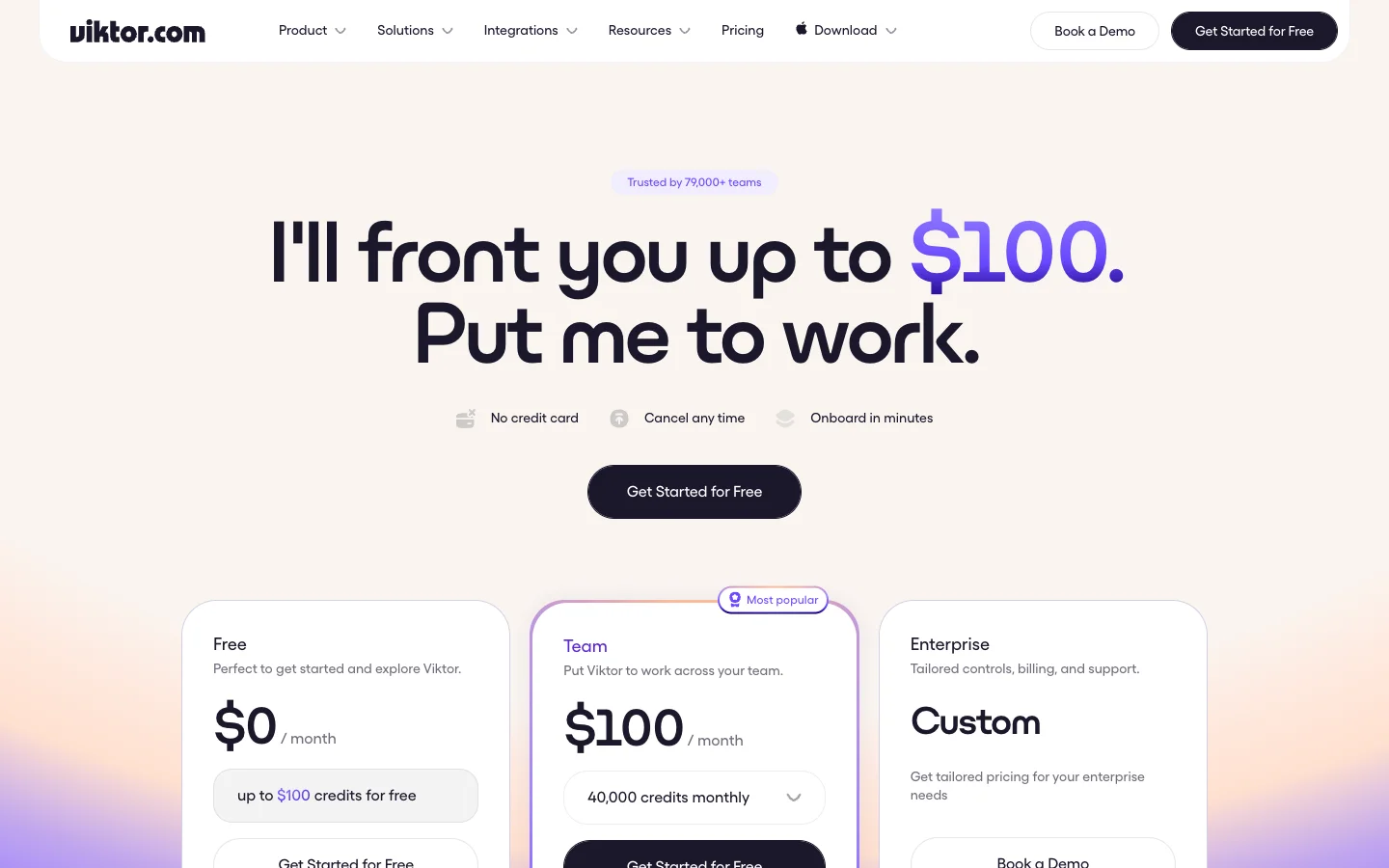 Viktor's Team plan buys one shared pool of 40,000 credits a month for the whole workspace.
Merlin
- Workspace plans are Starter at $9 a month (up to 3 active users, 1,000 requests), Team at $59 a month (up to 50 active users, 5,000 requests, with a 14-day cardless trial) and Scale at $99 a month (up to 200 active users, unlimited requests). There is no free tier.
- Per the prerequisites docs, a Merlin subscription does not include a model plan: "Model usage remains on the runtime owner's provider account and is subject to that provider's plan and usage limits." Merlin drives the Claude Code or Codex already installed on your team's machines.
- A request is one conversation or automation run, regardless of length or tool calls. If a workspace reaches its monthly request cap, new requests wait for the billing cycle to reset or an upgrade, with no per-token overage meter.
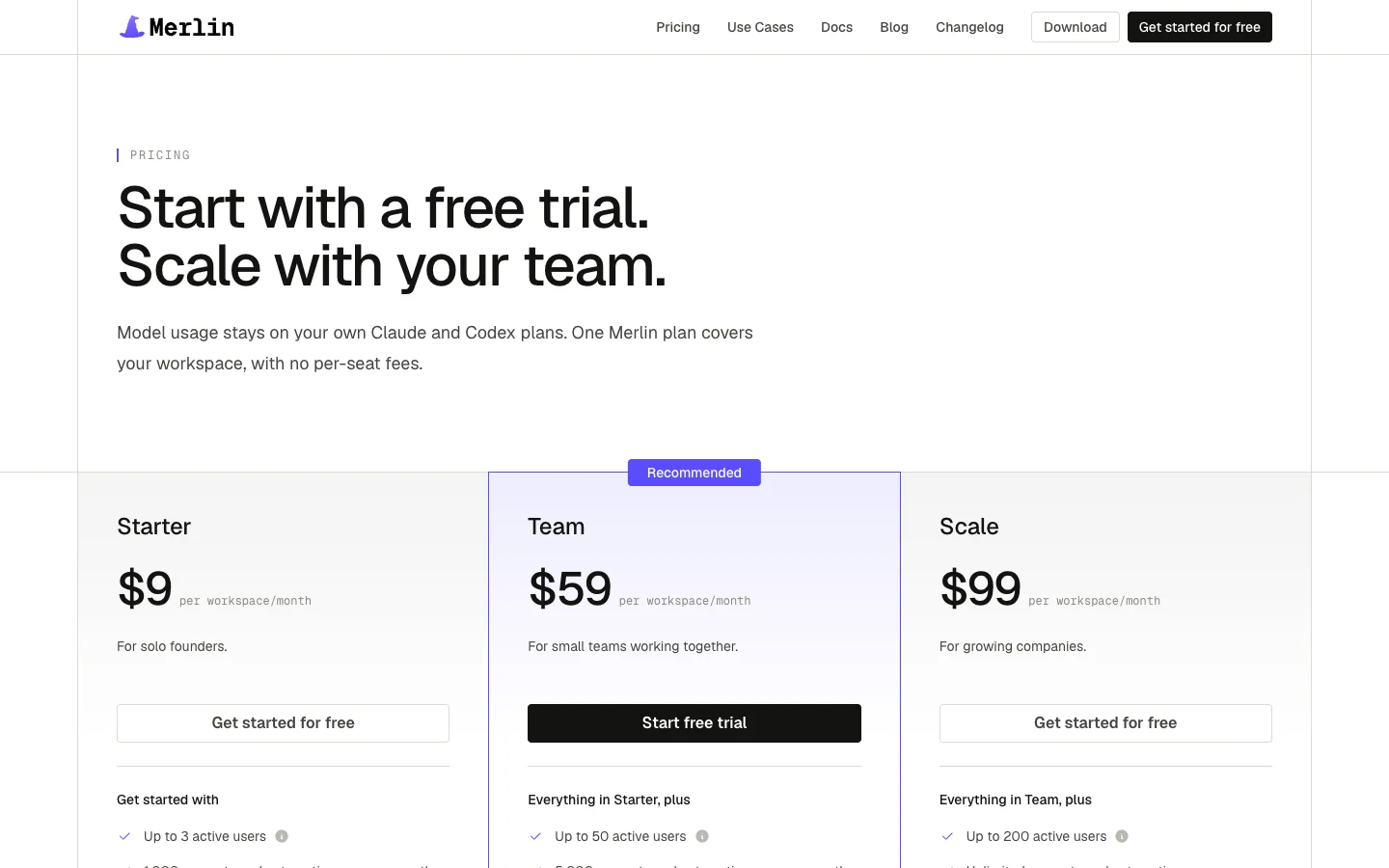 Merlin's plans are per workspace, and model usage stays on the team's own Claude and Codex plans.
What people say
- Viktor's own blog quotes a user on the starter pool: "The free trial is very generous but I burnt through 40,000 very quickly." (Viktor blog)
- On Trustpilot (where Viktor holds a 4.6 out of 5 across 123 reviews on November 12, 2026): "It does get costly fast...so be aware." and "Is the tool expensive at scale? Absolutely but its worth it." (Trustpilot)
- On Product Hunt: "costs less than your monthly coffee budget" from a light user, alongside "Learning how to manage the spending is important" and "the top-up pricing punishes the user." (Product Hunt)
My read: Viktor is easy to start for free, and then you manage a meter where long threads, browser steps and scheduled tasks all draw from one shared wallet. Merlin never sends you a token bill, and the trade-off is that someone on the team already has to pay Anthropic or OpenAI and live within their five-hour and weekly rate limits.
Where the work runs, data and compliance
The two tools make opposite architectural bets. Viktor gives your workspace a managed computer in its cloud, while Merlin routes tasks to the laptops, desktops or servers your engineers already run.
Viktor
- As the startup overview puts it, "Viktor arrives with his own computer in the cloud, a secure sandbox where he writes and runs code." According to its n8n comparison, "He cannot be self-hosted."
- Per the security page, workspaces run in isolated environments on AWS
us-east-1, with EU data residency and SAML SSO available on Enterprise contracts. Viktor is SOC 2 Type 1 certified (Type II and ISO 27001 in progress) and operates under zero-retention, no-training terms with its model providers. - Credentials for connected tools sit in a gateway that injects them at execution time so "the model never sees them" (security), while audit logs and per-user spend limits require an Enterprise plan.
Merlin
- Per Merlin's security docs, "Merlin does not host a model of its own and does not stand between your prompts and the provider." The macOS or Windows desktop app or Linux CLI daemon opens an outbound connection to Merlin, so you never open an inbound port (prerequisites).
- Repository contents, shell environments, personal MCP configurations and provider credentials stay on the machine, and Merlin sends the incoming request without uploading the working directory. Each conversation runs in its own working directory on the host machine, which the docs note "is not an operating-system sandbox or a separate user account" (security).
- If the machine running a task goes to sleep or loses Wi-Fi, it stops accepting work until it wakes back up.
My read: Viktor wins on turnkey infrastructure and compliance paperwork: you invite it to Slack and its cloud sandbox is live 24/7 with SOC 2 Type 1 in hand. Merlin fits teams that don't want to hand SaaS credentials or source code to a third-party cloud sandbox, provided you have a machine that stays awake.
Permissions
When you put an agent in a shared Slack workspace, the scary question is who can trigger actions using someone else's credentials. Viktor shares most SaaS connections across the workspace by default, whereas Merlin keeps every connected machine private to its owner until they choose to share it.
Viktor
- According to Viktor's connection docs, new integrations default to shared with "Everyone in the workspace", except personal tools like Gmail, Google Calendar, Google Contacts, Outlook and IMAP, which start private. The docs warn plainly that sharing a Google Drive connection with everyone makes "the files that account can see ... accessible to your whole team."
- Any connection can be switched to Private (Invite only), though background runs without a user behind them cannot use private connections.
- Each tool action can be set to Off, Run automatically or Ask for confirmation, so "Money moves, code pushes, and customer emails wait for your explicit approval in Slack" (security), and Slack reads respect what the asking user can see.
Merlin
- Per the security documentation, "New runtimes begin private. Only their owner can change them to public." When a runtime is private, only the device owner can send it work from Slack, Linear or GitHub.
- Making a runtime public lets teammates route tasks to that machine (including by asking to "use Alice's" in Slack), and model usage lands on that runtime owner's subscription (devices and runtimes).
- The docs are explicit about the trade-off of making a machine public: "A public runtime delegates real execution capability to eligible workspace members" and "Merlin does not ask the device owner for a new mid-run approval for each command" (security).
My read: Viktor's per-action approval buttons in Slack are great for risky SaaS writes, just remember to lock down shared Drive or Notion connections on day one. Merlin's default is locked down by owner, and if you open a public runtime for the whole company, it's best to run it on a dedicated machine with scoped credentials rather than a founder's personal laptop.
Integrations
Viktor brings a massive catalog of managed cloud OAuth connectors, while Merlin inherits whatever MCP servers, CLIs and local credentials your engineers already use on their machines.
Viktor
- Lists 27+ native integrations plus 9,800+ tools via managed connectors (up from 3,000+ in May 2026), powered under the hood by Pipedream (
pipedreamconnector kind in the public API docs). Most connect via one-click OAuth in the browser. - Supports custom REST APIs and remote MCP servers over HTTPS, while local MCP servers are not supported because Viktor runs in the cloud.
Merlin
- Ships server-side integrations for Slack, Linear and GitHub, plus inbound webhooks from Statsig, incident.io, Stripe, PostHog and Granola (automations). There is no managed catalog of 9,800 SaaS connectors.
- Because the work runs in Claude Code or Codex on the host machine, the agent can use any local or remote MCP server, database tunnel, internal CLI (
aws,gcloud,kubectl,gh) or skill installed on that machine (devices and runtimes). Teams can also publish workspace skills to a shared catalog.
My read: if marketing, sales and ops want to connect 15 SaaS tools via browser OAuth this afternoon, Viktor wins hands down. If your work needs local MCP servers, private VPC database access or authenticated cloud CLIs that never leave a developer machine, that's Merlin.
Where your team asks and how code work happens
Viktor is a broad company assistant across chat apps, email and hosted internal tools that can also clone repositories to open pull requests. Merlin is built around the software loop across Slack, Linear and GitHub.
Viktor
- Reaches teams in Slack, Microsoft Teams and email, plus Discord, a web app, Mac/Windows/Linux desktop apps and Android. It also includes Spaces for building and hosting full-stack internal web apps backed by workspace credits.
- Connects to Linear (106 actions) and GitHub (300 actions) as managed connectors. For code tasks, Viktor clones the repository into its sandbox, works on a branch, commits as Viktor, pushes and opens a pull request, spawning up to eight parallel helpers.
- Even so, Viktor's own Viktor vs Claude Code page advises: "Choose Claude Code if: Your main priority is working directly with a codebase and development tools."
Merlin
- Works in three places: Slack (mentions, DMs and threads), Linear (delegate or mention an issue to stream thoughts, plans and actions in a native agent session) and GitHub (mention
@usemerlin-aion an issue or pull request comment). - It does not support Microsoft Teams, Discord or email, and it does not host web apps.
- When asked for code changes, Merlin drives Claude Code or Codex directly on the connected machine, preparing the checkout with the device owner's local Git credentials.
My read: pick Viktor if your team lives in Microsoft Teams, Discord or email, or wants hosted internal web apps built from chat. Pick Merlin if your day revolves around Slack threads, Linear issues and GitHub pull requests, because driving the real Claude Code or Codex harness on an already-built local repo beats cloning into a cold cloud container.
Proactivity and automations
Viktor is proactive out of the box and checks in on your workspace twice a day, which also means background tasks can quietly eat into your credit pool. Merlin stays quiet unless invited and pins every automation to its creator's runtime.
Viktor
- Runs a system task called Heartbeat twice a day (around 9:00 and 15:00) to scan recent workspace activity and follow up on blockers, alongside Workflow Discovery, which can DM up to five teammates with automation ideas. As the docs note, "There is no single switch that turns off all proactive behavior at once."
- Supports scheduled tasks (defaulting to the Smart model preset) and event triggers from connected apps, webhooks or chat. Script-only scheduled runs cost zero credits, while AI runs spend from the workspace pool, and Viktor warns you when an AI schedule would fire more than about six times a day.
Merlin
- Each Slack channel has a response mode (
Mention only,Thread follow-upsorProactive), and a workspace-level setting gates any unmentioned replies. - Automations run on a schedule (daily, weekdays, weekly, monthly or fixed interval) or on events from GitHub, Linear, Slack, Statsig, incident.io, Stripe, PostHog and Granola, with an option to skip posting when there is nothing to report.
- Every automation runs on the specific runtime its creator selected from the machines they own, billing model usage to that owner's plan and counting as one workspace request per run. If that machine is asleep, offline or busy when the trigger fires, the run is skipped.
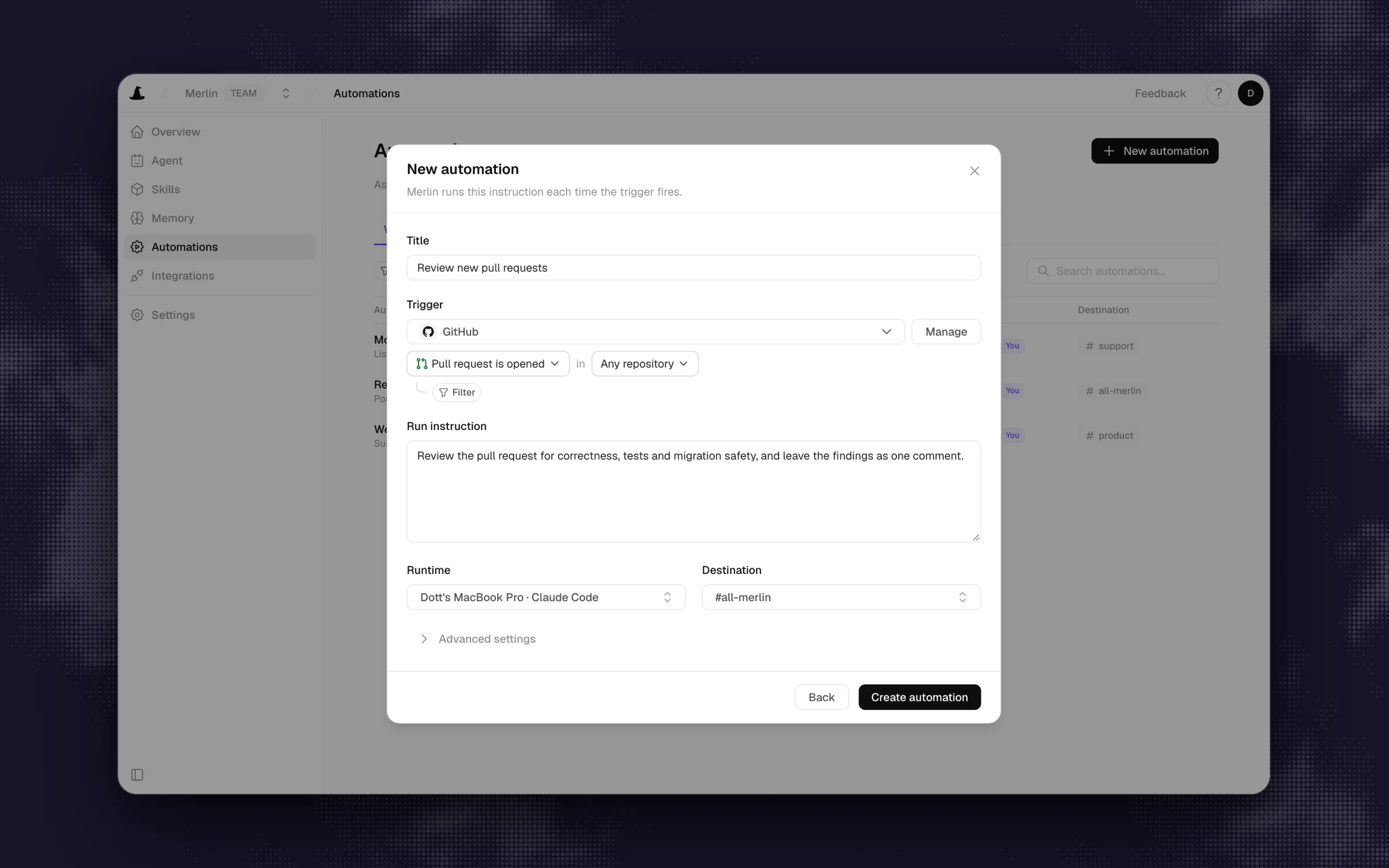 A Merlin automation names the one runtime it runs on, so its model usage lands on that runtime owner's plan.
What people say
- Viktor's own credit optimization post cautions users that "Scheduled automations are consistently the top credit consumer for active Viktor users."
My read: Viktor's cloud scheduler never misses a run because a laptop lid was closed, though you have to watch the credit burn on frequent AI schedules and tune down Heartbeat if you dislike unsolicited DMs. Merlin's automations carry no per-run dollar charge (each run counts as one workspace request and draws from the creator's runtime plan quota), provided you pin them to an always-on desktop or server so they don't skip while a laptop is in a backpack.
Memory
Both tools remember how your team works across conversations, using different boundaries for who can edit memory and who can see it.
Viktor
- Stores memory as skills ("Skills are how Viktor remembers your processes from one conversation to the next"), split into personal and shared workspace skills and refined overnight.
- Memory is scoped to the workspace and can be exported or deleted (security).
- Per the personalization docs, any workspace member can change Viktor's personality and shared instructions: "There is no admin check."
Merlin
- Stores memory as small Markdown files per Slack channel indexed by a
MEMORY.mdfile, and keeps memory turned off by default until an owner or admin enables it. - Public-channel notes form shared workspace memory, while private-channel notes remain readable only inside that private channel.
- Every stored fact records the Slack message it came from, and answers that use a memory cite that source message.
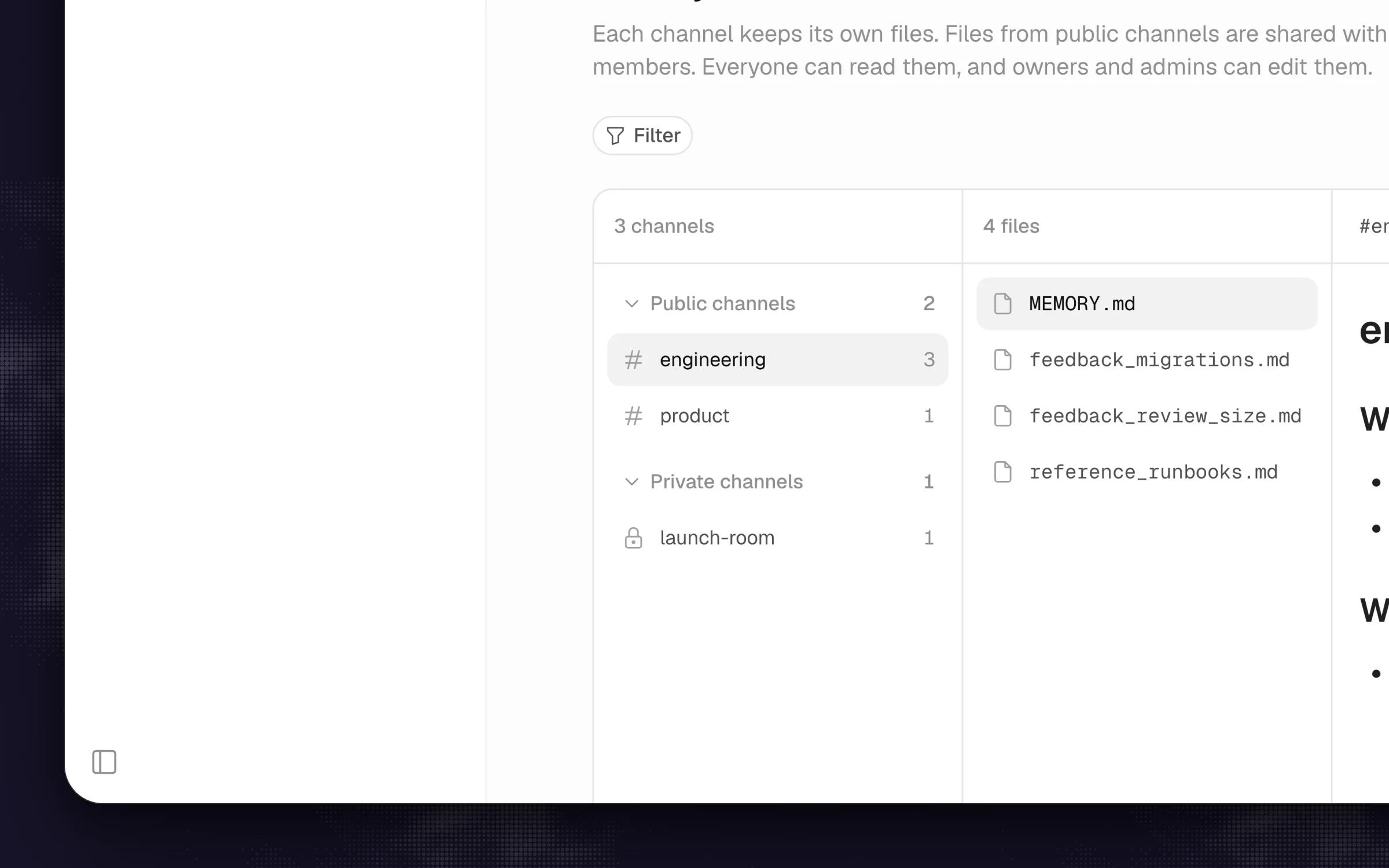 Merlin keeps memory per Slack channel, and a private channel's notes stay in that channel.
My read: Viktor's skill-refining approach is great for turning a messy chat workflow into a reusable recipe, though letting any member edit global instructions without an admin check can get lively in a 40-person Slack. Merlin's per-channel Markdown files with message citations and strict private-channel boundaries are easier to audit when leadership shares a workspace with the wider team.
Models
Viktor acts as a multi-model router across three providers, while Merlin relies strictly on the two leading coding agent harnesses.
Viktor
- Routes across Anthropic Claude, OpenAI and Google Gemini based on cost, latency and quality.
- Users and admins can set personal or per-channel defaults across four presets (
Ultra,Smart,BalancedandCheap), or type!fastand!deepin chat for a single reply.
Merlin
- Supports Claude Code and Codex only, giving you Anthropic's and OpenAI's models.
- The runtime owner picks the default model, reasoning effort and mode on their machine, and teammates can ask for adjustments like "max effort" in their prompt (devices and runtimes). Google Gemini and open-weight models are not supported.
My read: Viktor's per-channel model presets are a smart way to keep a noisy support channel on Cheap and save Ultra for deep research. Merlin gives you the native Claude Code and Codex harnesses directly, which is what you want if your team already swears by Opus or GPT-6 in the terminal and has no need for Gemini.
Which one should you pick
Four common team setups settle the choice quickly:
- Non-technical or mixed ops teams with no local coding agents: pick Viktor. You get up to 40,000 free starter credits to try it, 9,800+ one-click SaaS connectors, a cloud sandbox that never sleeps, and support for Microsoft Teams and email.
- Engineering-led teams (5 to 200 people) already paying for Claude Max or ChatGPT Pro: pick Merlin. Your workspace fee is a flat $9 to $99 a month, your engineers reuse their local repositories, MCP servers and CLIs, and you get native Linear agent sessions and GitHub PR work without buying a second pool of model tokens.
- Heavy automation and long-thread teams worried about runaway bills: pick Merlin with a dedicated always-on machine (like a Mac mini or Linux box on a $100 or $200 model plan). Every scheduled run and 30-message thread stays inside a predictable monthly outlay, though heavy weeks can still hit the provider plan's usage limits, which is the ceiling Merlin trades for the credit meter.
- Teams that want chat-built internal web apps (Spaces): pick Viktor. Merlin executes tasks and opens PRs, and never hosts web apps or databases for you.
5 things most comparisons skip
- Viktor's $50 ad vs the $100 pricing page. Viktor's ads still promote "Flat $50/mo", while the live pricing page starts Team at $100 a month for 40,000 credits and the docs state that for some workspaces $100 is the smallest plan offered.
- Thread history and browser steps multiply credit burn. Viktor re-reads the full thread on every new message and bills credits on every web browsing step, so a 25-message debugging thread costs far more than 25 single questions in fresh threads.
- Viktor's one-time top-ups cost more per credit than your plan. If you run dry mid-month and buy a manual top-up instead of turning on auto top-ups or upgrading your plan tier, you pay a premium per credit, and paused requests expire after eight hours at zero.
- Viktor connections default to shared. Merlin runtimes default to private. Connecting a Google Drive account in Viktor shares its visibility with the workspace unless you flip it to Private, while making a Merlin runtime public gives teammates real command execution on that machine.
- Asleep laptops skip Merlin automations. Because Merlin pins each automation to its creator's chosen machine, a scheduled digest set on a MacBook that's closed at 8:00 a.m. simply won't run.
FAQ
Viktor has a Free tier with up to 40,000 one-time starter credits (worth up to $100) that never expire. Paid Team plans on the pricing page start at $100 a month for 40,000 shared workspace credits, and plans scale at $25 per 10,000 credits ($200 for 80,000, $300 for 120,000 and so on), with unused monthly credits rolling over for one billing period. While some ads mention a $50 a month plan (20,000 credits), Viktor's documentation states that for some workspaces $100 a month is the smallest plan offered.
Every current Viktor plan prices credits at $25 per 10,000 credits, which is $0.0025 per credit ($2.50 per 1,000 credits). By Viktor's own estimates, a quick Slack question or summary takes 50 to 300 credits ($0.13 to $0.75), a complex multi-tool workflow takes 500 to 1,500 credits ($1.25 to $3.75), and a full project takes 2,000 to 5,000 credits ($5.00 to $12.50).
When a workspace hits zero credits, Viktor pauses all AI work and saves the blocked request. If a workspace admin adds credits via a top-up or plan upgrade within eight hours, Viktor automatically replays the paused request.
No. Viktor runs models in its own cloud environment and bills all model work through its workspace credit pool. If you want to put your existing Claude Code or OpenAI Codex subscriptions to work in Slack, Linear and GitHub, that is what Merlin is built for.
No. Merlin charges a flat workspace fee ($9, $59 or $99 a month) and routes tasks to Claude Code or Codex running on your team's own machines. Model usage stays on each machine owner's existing Anthropic or OpenAI account and follows that plan's five-hour and weekly usage limits.
If you want a zero-setup cloud agent with thousands of SaaS connectors and don't mind watching a credit meter, start with Viktor's free starter pool. If your engineers already pay for Claude Code or Codex and you want the whole team reaching those machines from Slack, Linear and GitHub for a flat monthly fee, give Merlin's 14-day trial a spin.
Try Merlin for free
Hand work to Claude Code and Codex from Slack, Linear and GitHub. Free for 14 days, no API keys, no card required.
Get started for free